
After the many articles written on the LactoSolution blog and the many questions received from people who are lactose intolerant like us, we realized that it is necessary to write a brief guide—but as complete as possible—on the topic of "lactose intolerance." Here you will find all the answers you are looking for, and if you should have further questions to ask, you can do so in the comments on the LactoSolution blog.

We will cover the following points:
- Lactose intolerance: what it is.
- Once intolerance is understood, let's define lactose.
- The symptoms and disorders that characterize lactose intolerance.
- The tests to diagnose lactose intolerance.
- Foods containing lactose, what to eat and what not to eat when you are lactose intolerant.
- The solution to lactose intolerance problems.
- Who to rely on to understand your lactose intolerance status and investigate other potential medical conditions?
- Medicines containing lactose.
- Online stores that sell lactose-free products.
- Lactose intolerance in infants and children.
- Legislative situation and support associations for those with lactose intolerance.
- Some theories on lactose intolerance.
1) Lactose intolerance: what it is.
Lactose intolerance is an organism dysfunction that involves the mal-digestion of lactose, the sugar present in milk and its derivatives. It is caused by a deficiency of the lactase enzyme, the catalyst responsible for processing lactose—that is, breaking it down into glucose and galactose to complete its digestion in the intestine. It is not an allergy, so it is not correct to say "lactose allergy." You can have an allergy to milk proteins, but that is a different thing (and, alas, without a solution).
Unfortunately, almost all people will face intolerance over the course of their lives because that has been the case for hundreds of thousands of years. In fact, until a few thousand years ago (it is thought about 7,000), as a human race, we did not have genes capable of keeping the lactase enzyme active after weaning. In other words, we were designed to consume milk only in the very first phase of our lives.
Due to the increasingly massive use of milk and milk derivatives even in adulthood, the human body is adapting, and therefore evolution is pushing us to maintain the lactase enzyme even after childhood.
Today, about 25% of people in the world have these modified genes, adapted to "modern" times, allowing them to digest milk and dairy products well. The remaining 75% are predisposed to lactose intolerance and will therefore become intolerant over the course of their lives. The lack of genes responsible for creating the lactase enzyme is called primary lactose intolerance.
Regardless of genes, in some cases, the intolerance is temporary. It can be due to antibiotic therapies that have decimated the presence of the lactase enzyme, or non-chronic diseases and inflammations. In this case, the body may return to producing the enzyme, and this is referred to as secondary lactose intolerance.
2) Once intolerance is understood, let's define lactose
Lactose is a disaccharide, a molecule formed by carbon and water, which is also called a glucide or sugar. It belongs to the oligosaccharide carbohydrates and is composed of two monosaccharides: glucose and galactose.
Other simpler carbohydrates are monosaccharides (glucose and galactose, precisely), and other more complex ones are polysaccharides, composed of more than ten monosaccharides each (such as starch, glycogen, and cellulose).
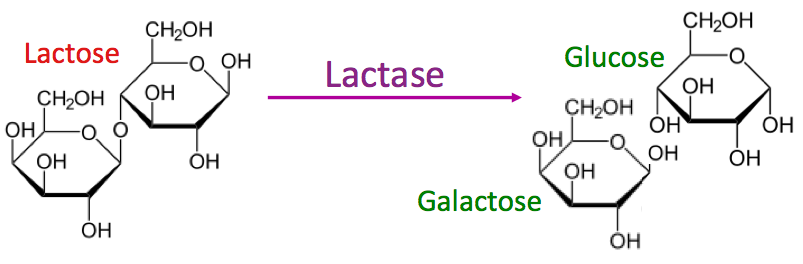
The only natural source of lactose is human or animal milk, which represents 98% of the sugars present in milk as well as about 5% of the total mass of the milk.
Lactose is used in the pharmaceutical industry as an excipient and in the food industry for the production of infant formula. Lactose is also used as a thickener, softener, and sweetener in some specific recipes.
3) The symptoms and disorders that characterize lactose intolerance
The symptoms of intolerance in adults or children are the same. Some are very common, and some can be found in less than 20% of the intolerant population. Erroneously, some might call them "lactose allergy symptoms."

The most common symptoms of lactose intolerance:
- Indigestion and constipation
- Increased peristalsis
- Flatulence and meteorism from 15 minutes to 3 hours after a meal
- Diarrhea or poorly formed stools from 1 hour to 3 hours after a meal
- Abdominal cramps, stomach aches, colic up to 24 hours after a meal
- A feeling of heaviness and abdominal bloating up to 36 hours after a meal
The less common symptoms of lactose intolerance:
- Dizziness and headache
- Nausea and vomiting
- Skin or throat irritation
- Itching
- Tachycardia
- Insomnia
- Constipation
- Irritability
- Fever
- Rhinitis
- Fatigue
- Decreased hearing
- Allergies
- Muscle and joint pain
- Prolonged abdominal pain
Where do these symptoms come from? The culprits are the good bacteria of the intestinal flora in the colon. Because of the absence of the correct enzyme, the lactose passes through the small intestine (the natural home of lactase) unchanged and enters the large intestine. It remains, therefore, for these good microorganisms to get rid of it, and in the process of fermenting the lactose, they produce waste products such as gas, hydrogen, and methane, and some toxins. These last substances cause the bloating, pain, and odors known to you.
The symptoms that afflict those with lactose intolerance are not specific, however; that is, you can have them even in the presence of other pathologies such as: presence of Helicobacter pylori, Crohn's disease, irritable bowel syndrome (IBS)... here we explain which ones in detail (LINK).
4) The tests to diagnose lactose intolerance
Among the tests for lactose intolerance, the most famous and most used is the Breath Test: the subject is administered a quantity of powdered lactose dissolved in a glass of water, and the hydrogen value in the breath is checked at regular intervals over the next 4 hours.

A value increasing by more than 20 parts per million of H2 indicates lactose malabsorption and therefore a condition of intolerance (which may be reversible. The test does not indicate if we will be intolerant forever or if it is a temporary condition).
It is performed in a hospital or at some analysis laboratories. Here is the LINK with the detailed description.
Today there is a new type of Breath Test that more and more hospitals are offering, and which, given the apparent higher quality and simplicity of execution, we wanted to offer in our online shop (www.lactosolution.com/shop) as well. This new methodology uses Carbon-13 instead of Hydrogen and is called the C13 Breath Test or Carbon Breath Test.
In the case of the Carbon Breath Test, the amount of lactose to be ingested is half compared to the Hydrogen Breath Test, and the duration is also halved. We propose a test to be carried out at home, completely identical to that offered by the best hospitals... better to go to the bathroom at home than in the hospital ward!
The second test to diagnose lactose intolerance, complementary to the Breath Test, is the genetic test: with a saliva sample (buccal swab), the subject's genetic structure is studied.
Also called a DNA test for lactose intolerance, during the analysis of the swab, a particular genotype of our DNA is checked that indicates if the body will undergo a decrease in the production of the lactase enzyme (a non-reversible condition). This can also be carried out in a hospital, in analysis centers, and also, in some cases, by sending a sample remotely. We also have a specific article for this test (LINK).
Only the combination of both tests allows for the diagnosis of the subject's current intolerance condition 100%.
A third examination method for diagnosing the condition of lactose mal-digestion is the lactose tolerance blood test. It is a rarely prescribed test that is performed on a blood sample by measuring glucose (blood sugar). It detects the conversion of ingested lactose into glucose and galactose.
5) Foods that contain lactose, what to eat and what not to eat
Where is lactose found?
There is a lot of confusion about the presence of lactose in foods. Let's try to clarify.
Some foods naturally contain lactose. Among them are: milk and all its derivatives such as cheese, buffalo mozzarella and regular mozzarella, processed cheese slices, cream, heavy cream, stracchino, robiola, yogurt. Dishes prepared with milk derivatives such as the beloved breakfast cappuccino, cannelloni, lasagna, ravioli, and béchamel sauce for lunch, and

Other foods contain lactose because it is normally expected in their production or in their recipe, and you must be wary of them regardless.
To understand if they are lactose-free, you have to check the label... the word "lactose" must not be present among the ingredients.
You shouldn't worry, however, about the phrase "May contain traces of milk," because this phrase informs you that milk and dairy products are handled in the vicinity of the food's production line, and some contamination may be possible (negligible contamination for us who are intolerant, more important for those who have allergies in which even a few molecules of allergen can trigger significant reactions).
In this "category of foods" we find sweets in general, from cookies to cakes (tiramisu, panna cotta, custard), milk chocolate, packaged snacks, bar croissants, corn flakes, coffee capsules, cappuccino, and even savory foods such as pies and bakery preparations, pizzas, focaccias, milk bread rolls, snacks, and energy bars.
Be careful with homemade dishes like cannelloni, lasagna, and risotto, perhaps seasoned with béchamel sauce. Vitamin supplements and lactic acid bacteria (probiotics) could also contain lactose.
Finally, fast food (hamburgers, hot dogs, sandwiches with cutlets or fillings) is king, along with sauces (Greek, yogurt, barbecue), ready-made meals (soups, risottos, ready-made sauces), and candies.
The same rule applies to ice cream... usually all cream flavors contain lactose, but not fruit ones. When in doubt... ask the shopkeeper.
Cured meats: hard salami and soft salami, cooked ham, and other soft and non-aged specialties often contain lactose.
Lastly, foods that should not contain lactose.
Although some producers might insert lactose into the production processes of these foods for particular purposes, usually you can be safe in purchasing them. In fact, there should be no trace of lactose in:
- Alcohol (including spirits, wines, and beers)
- Meats (chicken, beef, pork, and game)
- Pure or dark chocolate, coffee powder
- Fruit (apricots, sour cherries, pineapple, avocado, bananas, cherries, watermelon, dates, kiwi, raspberries, almonds, apples, melons, blueberries, blackberries, hazelnuts, walnuts, peaches, pistachios, grapefruit, plums, grapes, etc.)
- Normal bread and simple flours
- Fresh fish (salmon, sardines, tuna, swordfish, trout, mollusks, octopus, etc.)
- Livestock products such as honey, eggs, caviar, etc.
- Rice
- Spices and condiments (including oil, vinegar, basil, rosemary, pepper, asparagus, cinnamon, cloves, curry, oregano, paprika, mint, chili, poppy seeds, mustard, mayonnaise, ketchup, salt, sugar)
- Vegetables and produce (including lettuce, salad, broccoli, potatoes, artichokes, tomatoes, zucchini, beets, radishes, beans and green beans, turnips, broccoli, artichokes, carrots, cauliflower, cabbage, cucumbers, corn, onions, garlic, lentils, peppers, peas, radicchio, radishes, rye, popcorn, spinach)
- Fruit juices and other preparations of the above foods without additives.
And what about the foods in the first "category" that are advertised as "lactose-free"?
Lactose-free milk, lactose-free mozzarella, lactose-free cream... what are they?
Some producers have understood the importance of the lactose-free sector and have started to treat their foods with industrial lactase enzyme in order to guarantee greater digestibility of the product even in the absence of overt symptoms of intolerance by the consumer. The lactase enzyme causes the hydrolysis of lactose, converting it into glucose and galactose. These products are called delactosed, hence the more user-friendly terms:
"lactose-free," "lactose < 0.1%," "lactose < 0.01%"

Attention, these products have a percentage of lactose that is not negligible for most intolerant subjects. The case history tells us, in fact, that those who consume delactosed products daily soon return to having the same symptoms of intolerance in a very short time. In fact, the lactose is there! Little, but it is there, and the body "struggles" to digest it, leading to inflammation of the intestinal tract.
How can I replace foods that naturally contain lactose instead of taking the same ones but delactosed?
There are many alternatives. For example, instead of cow's milk, you can have almond milk, rice milk, soy milk, quinoa milk, or the milk of other cereals. Instead of butter, you can use margarine.
And instead of cheese? The cheese itself! Provided it is aged at least 24 months. During aging, in fact, the lactose is naturally broken down, and in the long term, the quantity reported is so low that it does not commonly cause problems, whether it is pecorino cheese, Grana Padano, or Parmigiano Reggiano.
For yogurt, on the other hand, there is no natural lactose-free alternative; one must resort to delactosed yogurts (Zymil, Amo Essere...). If you want to discover the properties of yogurt, click here (LINK).
A separate mention goes to whey proteins. This wording can be found on many food labels and does not imply the presence of lactose in the product. The possible presence of lactose must mandatorily be indicated separately on the product packaging.
Be careful, however, with protein food supplements (milk proteins, the ones for the gym, so to speak) as it is very difficult to find them without lactose in their composition. Look for whey protein isolates and read the nutritional labels carefully if you want to supplement your diet with high-protein products.
6) The solution to lactose intolerance problems
Most people—and many doctors, too—think that there is no solution to lactose intolerance. Instead, fortunately, that is not exactly the case.
While it is true that the condition of lactose intolerance is not reversible (unless it is a temporary or secondary intolerance due to specific disorders), it is equally true that to not suffer its effects, there is a very simple solution.
Instead of buying the aforementioned products advertised as lactose-free, it is enough to take the lactase enzyme orally to digest the lactose contained in all common foods!
The degradation of lactose that occurs within our body when taking one or more tablets of a good lactase enzyme supplement is completely similar to the breakdown of lactose that would occur in the case of the same lactase enzyme being produced by the body. You will no longer have to worry about rushing to the bathroom after eating your favorite mozzarella pizza or your friend's birthday ice cream cake if you use a good lactase supplement product.
The effectiveness is high, so much so that for 95% of the people we interviewed, this method works great (with the product Lactosolution 15000). The classic pains and discomforts disappear, and you may only experience some minor secondary discomfort that does not, however, affect living well.

This effectiveness, however, is only valid if the enzyme taken is of a certain type, namely lactase enzyme (not beta-galactosidase) and if the dosage is sufficiently high. Since the correct dosage varies from person to person and even from one day to another based on what we eat (you can learn more by reading an interesting article HERE - LINK), it is necessary to opt for products with a high concentration of the active ingredient lactase like Lactosolution 15000.
The lactase supplement is not a drug but, in fact, a nutritional supplement. This means it has neither contraindications nor side effects.
To ensure good effectiveness, follow the advice for taking the lactase enzyme from this article of ours (LINK, click HERE).
In support of the enzyme supplement, you can take probiotics to help maintain a functional intestinal flora. Enterogermina, Enterolactis Plus, Probinul, and Proflora Guna are good alternatives without lactose in their composition. However, we always recommend seeking medical advice before making any decision regarding your health.
7) Who should you trust to understand your intolerance status and investigate any other pathologies?

The most suitable professional to investigate the onset of symptoms is the gastroenterologist. They will be able to indicate which tests to perform, and above all, understand if there are the requirements to undergo a colonoscopy. They will be able to suggest any medications and supplements and will give you, based on data, your health status.
Once you understand that you are intolerant, you can rely on a good nutritionist for the diet to follow. A biologist nutritionist has the skills to ensure peace of mind for your intestine; they understand the impact of lactose in an intolerant body and will know how to help you make your lifestyle choices.
The pharmacist, on the other hand, will be fundamental for choosing lactose-free medications and lactose-free foods available on the market.
8) Medications containing lactose
Many, too many drugs contain lactose. To date, there is no contraceptive pill, for example, that does not contain lactose.
Some lactose-free antibiotics that, following medical prescription, you could take without problems related to lactose intolerance are the following:

- Ambramicina
- Augmentin
- Bramicil
- Cedax
- Ciproxin
- Gentomil
- Levoxacin
- Unixime
- Zitromax in oral suspension
If you cannot find a suitable lactose-free alternative to the prescribed medication, remember that there are lactase enzyme supplements that can solve the problem for you.
9) Online stores that carry lactose-free products
Some stores are specializing, and some have quite a few lactose-free foods in their catalog.

I will list two where I shop regularly; by clicking on the name, you will access the website:
10) Lactose intolerance in infants and children
Can children be lactose intolerant?
Yes.
And as with adults, the intolerance can be congenital or acquired.

Attention must be paid to correctly understand the condition of intolerance in little ones. In fact, the symptoms are the same as those seen previously for adults (diarrhea in infants, flatulence, bloating to which the infant's crying is added) and are comparable to the ailments that every newborn faces daily in the first months and years of life.
11) Legislative situation and associations supporting the lactose intolerant
Unlike celiac disease (i.e., gluten intolerance), lactose intolerance is not a pathology supported by government funds. In practice, the intolerant person must bear the burden of purchasing specific products entirely at their own expense, without any subsidy.
There is an association that fights for our rights, it is called the Associazione Italiana Latto-Intolleranti (AILI) and offers a membership card with which it proposes discounts and information on the topic. The Association's policy does not seem to be to help producers of lactase enzyme supplements but rather to push for lactose-free products; in fact, they also sell an Lfree certification...
12) Some theories on lactose intolerance
We conclude the discussion of the topic by informing you of two "opinions," two "movements of thought" that are often encountered when talking about lactose intolerance.
A) “A period of lactose-free diet -also called detoxification- makes the intolerance recede”
Many believe that if a person suffering from lactose intolerance stops consuming lactose for 6 months or more, the symptoms tend to disappear. Some even say that after this period the person could return to tolerating lactose and therefore eat foods that contain it.
According to this theory, lactose accumulates as we eat foods that we shouldn't, until it saturates the body and makes us feel bad. By stopping eating milk and dairy products, that is, by zeroing out the consumption of lactose, what is already accumulated in our body should slowly disappear and we would have a higher tolerance threshold than when we started the diet.
Some erroneously call this period detoxification (erroneously because lactose is not a toxic substance for our body, as much as it can cause us problems. Toxins are, in fact, represented by: alcohols, i.e., alcohol-type molecules, aldehydes, methylglyoxal, acetones, short-chain fatty acids).
What does scientific literature say about this?
Please comment by linking the source if you find any publication in favor of this theory because I have not found any data regarding a persistence of lactose for such a long period in our body.
Lactose follows the normal cycle of digestion and is expelled from the body through feces within 48 hours. Over a period of 2-3 days, therefore, the "accumulation" effect has its own logic, and continuing to consume lactose in the short term can only lead to an aggravation of symptoms.
Suspending the intake of lactose for a few days and taking it on alternate days is certainly a good and right thing. Forcing oneself not to take it for 6 months does not seem to have a scientific reason. What is certain is that the intolerance will not disappear even after 1 year of a strict diet. As we have seen, in fact, the most common lactose intolerance is due to the lack of the lactase enzyme for genetic reasons, and genes do not backtrack so easily.
B) “Not eating lactose makes us become intolerant”
I have personally interviewed several doctors on the topic. An interesting theory, but also not confirmed by scientific publications, believes that abstaining for a prolonged period from foods with a high lactose content can cause a decrease in the production of the lactase enzyme in our body and therefore the onset of lactose intolerance.
A clear example is the boy who replaces milk with tea at breakfast for the entire period of secondary school. There are some cases in which intolerance manifested following this behavior, but questions arise: "would the boy have become intolerant anyway if he had continued to consume milk?" or "perhaps he felt like switching to tea because he perceived some discomfort with milk (preliminary signs of lactose intolerance already in progress)?".
In the absence of sufficient scientific documentation, this theory remains a hypothesis. For our part, we can be careful not to eliminate milk from our diet entirely so as to hope that the production of lactase enzyme by our body never stops. A subject who is genetically predisposed will not, however, benefit from this tactic, at least not in the long run.
It is worth noting how the two theories presented are in stark contrast. According to the latter theory, in fact, a strict lactose-free diet as proposed in the first theory could lead to the total cessation of lactase production within the body with effects of intolerance that are even more severe than when one started the diet itself.
Personally, after 10 years of intolerance and more than 500 interviews, I am more inclined towards the second theory. Also assuming the fact that more and more doctors indicate it is incorrect to totally eliminate lactose from the diet of those who are lactose intolerant, trying instead to understand what threshold makes us feel bad and which one we tolerate. This is because milk and dairy products provide many nutrients to our body, some of which are not otherwise assimilable.
A good lactase enzyme supplement will be your greatest ally in order to support a complete lifestyle diet, leaving you the freedom to choose what to eat from time to time.
I have provided many in-depth links; the goal is to make it easy for you to understand what it means to be lactose intolerant nowadays.
Furthermore, you can follow some Facebook groups on lactose intolerance where people give each other advice (be careful, however, to filter information... in these contexts, people too often talk without any scientific basis or preparation).
I hope you liked my article. On our site, you can find the form to subscribe to the Lactosolution newsletter, useful for receiving updates from the best BLOG related to lactose intolerance!
Faced with all this, what is your idea or your question? Write it below!
Purchase link for the Lactosolution 15000 lactase enzyme food supplement: click HERE (LINK)!
If you liked this article, share it with your friends or give it a like on the Lactosolution Facebook page
References
- Nielsen data
- Lehninger Principles of Biochemistry, Fifth Edition; David L. Nelson and Michael M. Cox
- European Journal of Biochemistry, various articles
- American Journal of Clinical Nutrition, various articles
- Paolo Silvestrini - Fundamentals of Chemistry
- Questionnaires submitted to intolerant people 2017, 2018, 2019 by Lactosolution